

 By
By 
Picture a kid learning to shoot free throws.
First shot: airball, way too far left. Second shot: hits the rim, a little better. Third shot: swish.
Nobody handed that kid a physics textbook on projectile motion. They just threw the ball, watched where it landed, and nudged their next attempt based on the error. Miss left, aim right. Miss short, push harder.
That’s it. That’s how machine learning learns.
Strip away the intimidating math notation and the buzzwords, and every machine learning model on Earth from the one recommending your next YouTube video to the one powering self-driving cars is doing the exact same thing as that kid at the free throw line. Guess, check the miss, adjust, repeat. Thousands, sometimes billions of times.
Let’s actually go under the hood and watch the knobs turn.
This is the starting point for how machine learning learns from complete randomness toward something useful.
.
Step 1: The Model Starts Out Genuinely Clueless
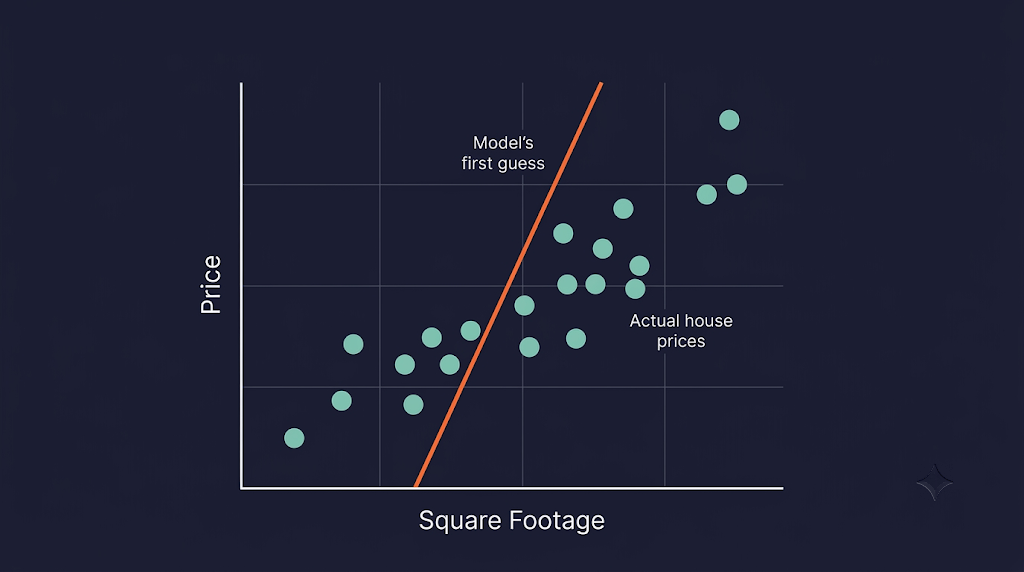
Here’s something that surprises people: a brand-new, untrained machine learning model isn’t smart. It isn’t even mediocre. It’s basically making random guesses.
Say you’re building a model to predict house prices based on square footage. Internally, that model is just a simple equation:
Price = (weight × square footage) + bias
At the very start, “weight” and “bias” are just random numbers, maybe weight = 0.3, bias = 10. Total nonsense. Plug in a 1,000 sq ft house, and the model might confidently predict it costs $310.
It’s wrong. Wildly wrong. And that’s expected day one of learning always looks like day one of that kid’s free throws.
Step 2: Measuring the Miss (This Is the “Loss”)
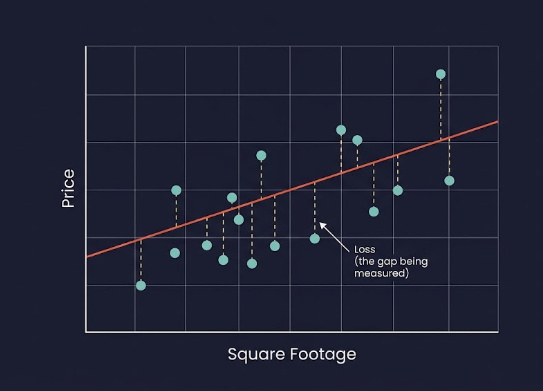
Now here’s the part every intro course glosses over: how does the model even know it’s wrong, and by how much?
This is where a “loss function” comes in and despite the intimidating name, it’s genuinely just a distance-measuring tool.
Say the actual house sold for $200,000, but the model predicted $310. The loss function looks at that gap and spits out a single number representing “how bad was this guess.”
A bigger miss = a bigger number. A smaller miss = a smaller number.
That’s the entire job of a loss function. It’s the coach standing courtside going, “That shot missed by four feet.” No coaching advice yet just an honest, brutal measurement of the miss.
Without this step, there’d be no way to understand how machine learning learns from its own mistakes.
Step 3: Figuring Out Which Way to Nudge the Knobs

This is the actual “learning” part, and it’s the piece most explanations butcher.
Remember, the model has knobs, weight and bias. The question is: which direction do I turn each knob to make the loss smaller next time?
This is done through something called gradient descent, and here’s the analogy that actually makes it click:
Imagine you’re standing on a hill in thick fog. You can’t see the bottom of the valley, but you can feel which direction the ground slopes under your feet.
So you take a small step downhill. Then you feel the slope again from your new spot, and take another small step. Repeat enough times, and you’ll eventually reach the bottom of the valley even though you never once saw the whole landscape.
The “gradient” is just the slope you feel under your feet at your current position. It tells the model: “if you nudge weight up a tiny bit, does loss get better or worse? What about bias?”
Concretely, with real numbers:
- Current weight: 0.3, causing a $310 prediction against a real $200,000 sale (a massive loss, obviously exaggerated for teaching purposes)
- The gradient calculation says: “increasing weight makes the loss shrink”
- So the model nudges weight from 0.3 to, say, 0.35
- Recalculates. Loss is smaller. Good. Nudge again.
This nudge size is controlled by something called the learning rate, think of it as stride length on that foggy hill.
Too big a stride, and you might overshoot the valley entirely and stumble up the other side.
Too small a stride, and you’ll take forever to get anywhere. Getting this number right is genuinely one of the trickiest parts of training a real model.
To learn more about gradient descent: https://en.wikipedia.org/wiki/Gradient_descent
Step 4: How Machine Learning Learns Through Repetition (Training)
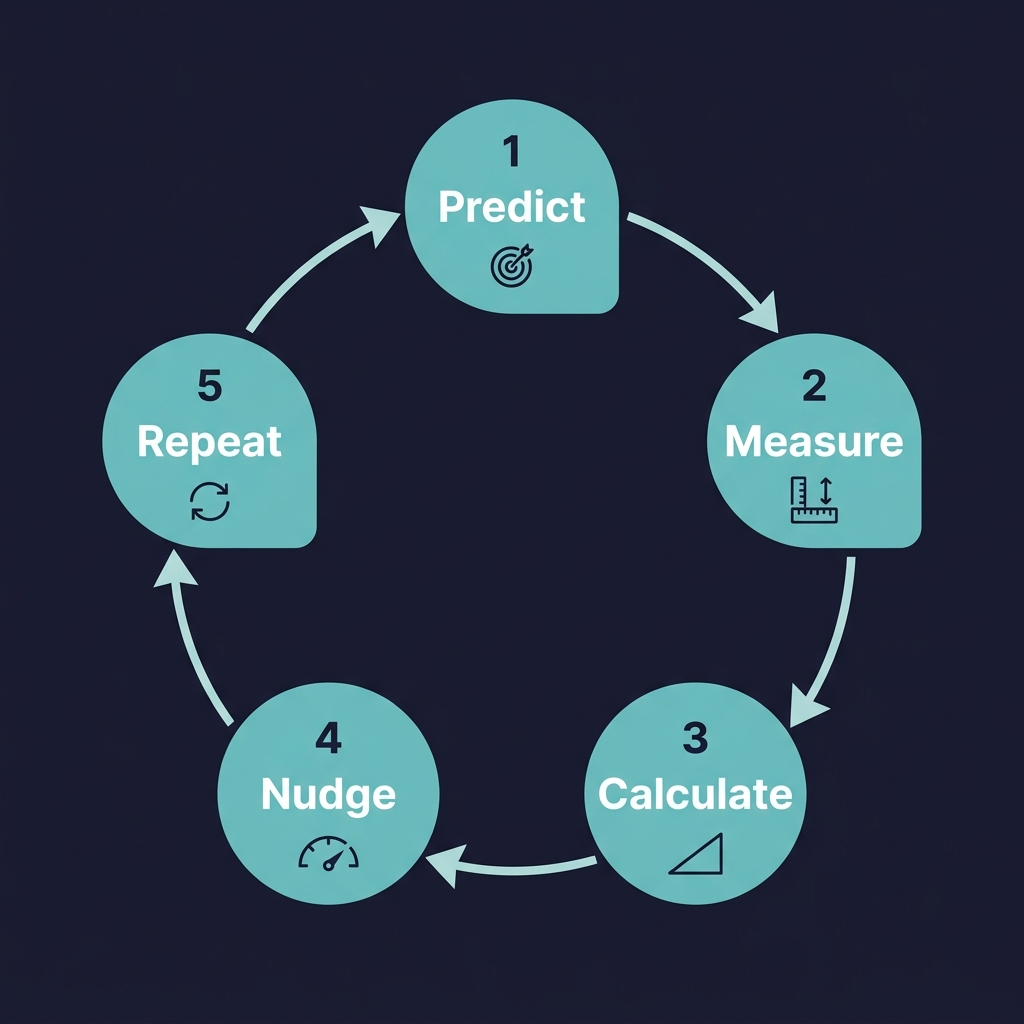
One nudge doesn’t make a kid a free-throw champion, and one gradient step doesn’t make a model smart.
What actually happens is this loop, running over and over:
- Make a prediction
- Measure the loss (how wrong was it)
- Calculate the gradient (which direction reduces the loss)
- Nudge the weights slightly in that direction
- Repeat with the next example
Each full pass through the training data is called an epoch. Real models often run through their training data dozens or hundreds of times, making millions of these tiny nudges along the way.
Slowly, weight and bias stop being random garbage and start converging toward numbers that actually predict house prices reasonably well. Not because the model “understood” real estate but because it mechanically minimized its errors, guess after guess after guess.
Step 5: Why This Explains AI’s Weirdest Behaviors
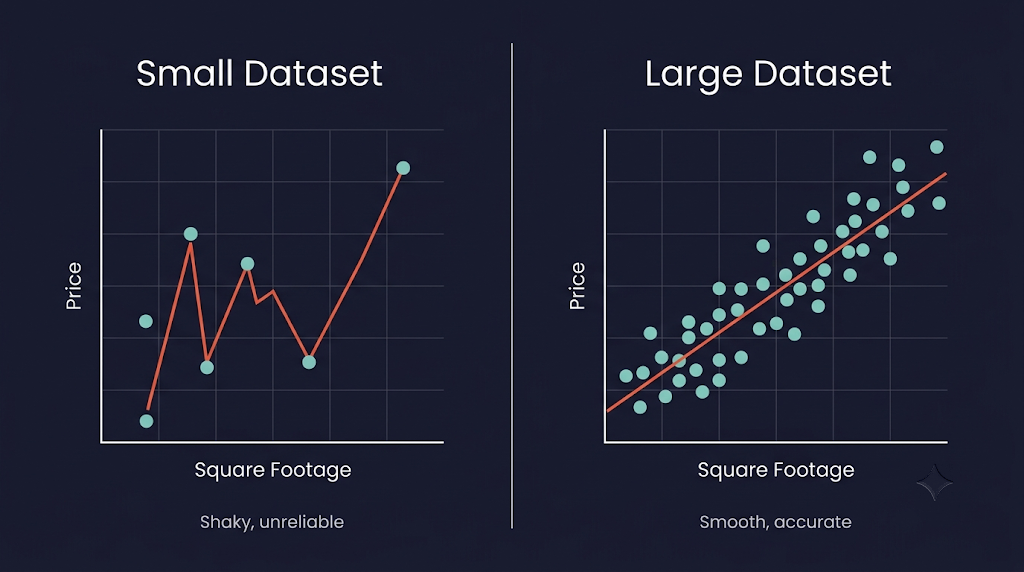
This mental model guess, measure the miss, nudge, repeat explains a lot of AI quirks that otherwise seem mysterious.
Why does AI need so much data?
Because each individual nudge is tiny. The free-throw kid needs hundreds of shots to develop real intuition, not three. A model needs thousands or millions of examples for those small nudges to add up into genuinely useful behavior.
Why do AI models “hallucinate” or make confident mistakes?
Because the model was never taught truth it was only taught to minimize loss on its training examples. If a wrong answer happens to minimize loss in a way that generalizes poorly, the model will confidently produce it anyway. It doesn’t know it’s wrong. It just knows it once made the loss number small.
Why does more computing power make AI “smarter”?
This is another piece of the puzzle in how machine learning learns patterns that are too complex for smaller models to capture. More computation means more nudges can happen faster, on more data, with more knobs (parameters) being tuned simultaneously. A model with a billion weights being nudged is capable of representing far more nuanced patterns than one with a hundred.
The One-Sentence Version
If you remember nothing else: machine learning is not the computer “understanding” anything; it’s a very patient, very mechanical process of guessing, measuring exactly how wrong the guess was, and nudging a huge number of internal knobs a tiny bit in the direction that makes future guesses less wrong.
Do that enough times, on enough examples, and something that looks a lot like intelligence falls out the other end. Not because it thinks like us but because it never stops adjusting its aim.
That, in a nutshell, is how machine learning learns, not through understanding, but through relentless, mechanical repetition.
2 Comments