

 By
By Last month I asked a chatbot to book me a flight. It handed me a list of airline websites and wished me luck. A friend of mine asked an AI agent to do the exact same thing. Hers just… booked the flight. Confirmation email and all.
Same request, two totally different outcomes. That’s basically the whole story of what’s happening in tech right now, and somehow almost nobody bothers to explain it without fifteen buzzwords.
AI Agent vs Chatbot: The Core Difference
A chatbot answers. An agent acts.
Here’s how I think about it: a chatbot is a really, really smart search engine that happens to talk back in full sentences. An agent is more like a digital employee. You give it a goal, it figures out the steps on its own, and it goes and does them. You’re not standing over its shoulder for every single click.
Small distinction on paper. Huge difference in real life.
AI Agent vs Chatbot in Real Life: The Coffee Break Test
Let’s make this concrete. Say you want three days off next month.
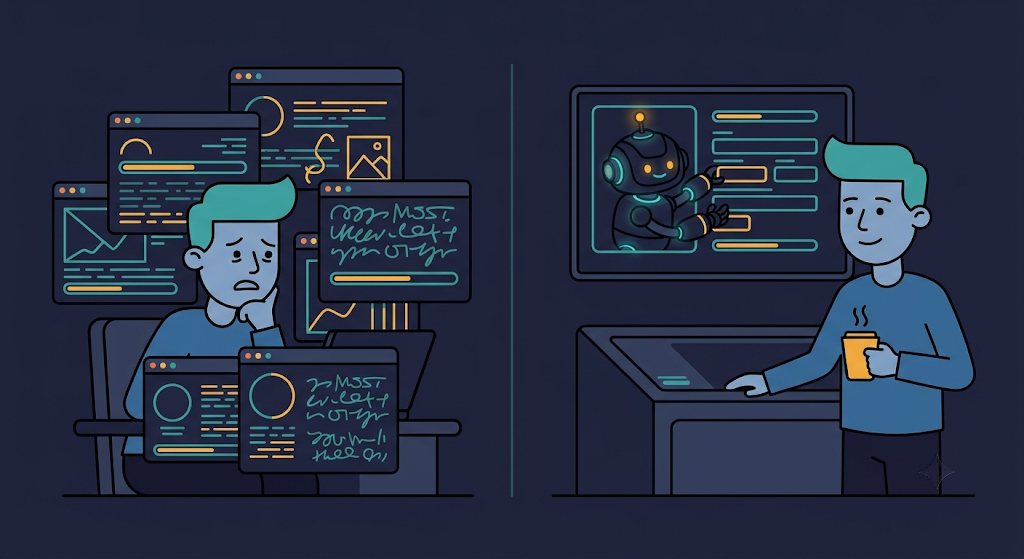
Ask a chatbot “how do I request time off at my company” and you’ll get the textbook answer: check the HR portal, tell your manager, follow policy. Fine advice. Except you’re still the one opening the portal, picking dates, writing the message to your manager, and squinting at your calendar to make sure nothing conflicts. The chatbot did the thinking part. You’re stuck doing the doing part.
Ask an agent to “book three days off next month, just avoid my team’s sprint deadline” and something different happens. It pulls up your calendar. Spots the sprint deadline. Picks dates around it. Fills in the HR form. Even drafts and sends the note to your manager for you. You just glance at the result instead of grinding through five separate steps.
Same request. Wildly different amount of Tuesday-afternoon work landing on your desk.
AI Agent vs Chatbot: The 3 Practical Capabilities That Actually Separate Them
None of this is marketing fluff, by the way. There are three actual technical capabilities doing the heavy lifting here, and once you see them you can’t unsee them.
1.Reasoning (Multi-Step Planning, Not Just Answers)

A chatbot answers whatever’s in front of it, full stop. An agent takes a fuzzy goal, breaks it into smaller pieces, works through them in order, and course-corrects when step three doesn’t go the way step one assumed it would.
I like the GPS comparison here. A chatbot is a GPS that only ever tells you the next turn. An agent is the GPS plus an actual driver, one who reroutes around traffic without stopping to ask permission at every intersection.
Try this yourself: ask “what’s the cheapest way to furnish a studio apartment” and a plain chatbot gives you five bullet points of general advice. A genuinely agentic tool goes and checks live prices across a few retailers, compares shipping costs, and comes back with an actual shopping list and a real total. Not “tips.” A number.
A number. That’s the ai agent vs chatbot gap in action, not theory. (If you want the deeper mechanics of how these systems actually make decisions step by step, IBM has a solid technical breakdown of AI agents worth reading.)
https://www.ibm.com/topics/ai-agents
2. Tool Use and Real Actions
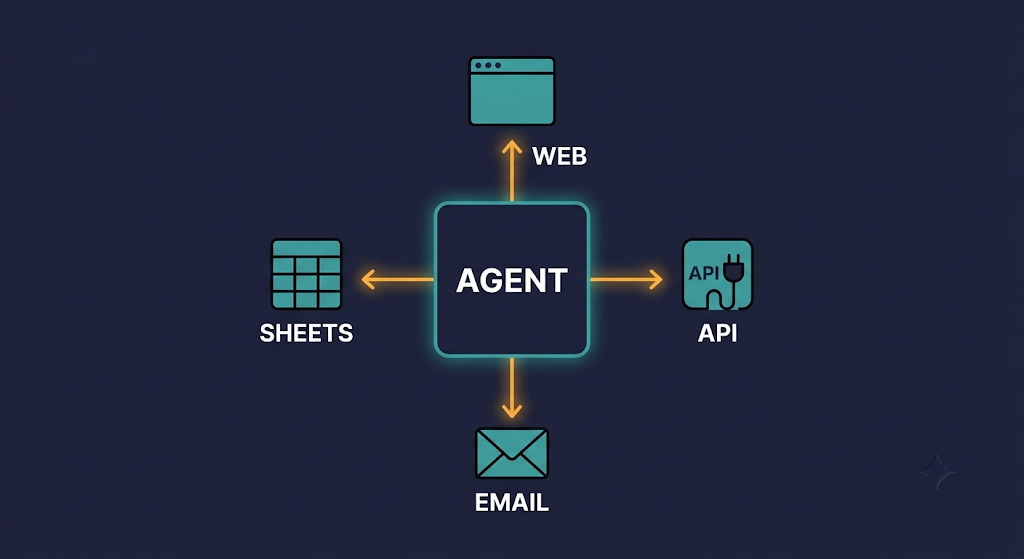
Honestly, this is the big one. A chatbot lives entirely inside a text box. An agent gets to leave the box.
What that looks like in practice:
- Browsing the live web, not just recalling whatever it memorized during training
- Calling APIs to check real flight prices, weather, stock levels, whatever
- Filling out forms, firing off emails, updating a spreadsheet somewhere
- Running actual code to calculate something instead of eyeballing an estimate
There’s a real gap between “here’s how you’d write that spreadsheet formula” and “here’s your spreadsheet, already built.” One’s a tutorial. The other’s a finished thing.
3. Memory and Autonomy
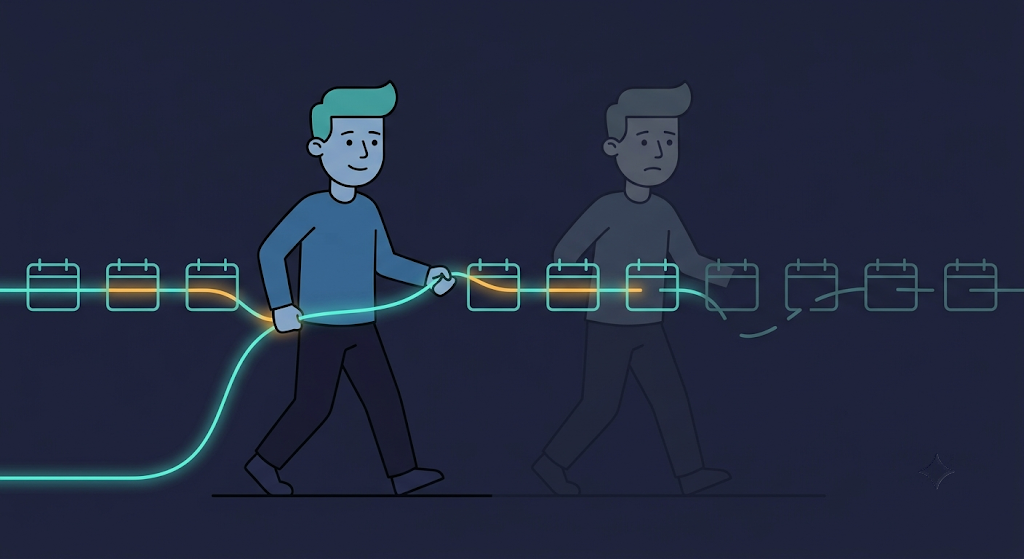
A basic chatbot forgets you the second the tab closes, or at best it remembers stuff within that one conversation and nothing more. An agent can hold onto context across a whole task, sometimes for days at a stretch, and keep chugging along without you checking in every ten minutes.
Put simply: one is a helper you have to remind constantly, the other is a helper who remembers the whole project and only pings you when something’s actually done, or actually stuck.
And honestly, autonomy is the real multiplier here, not raw intelligence. It’s less “the agent is smarter” and more “you can hand it a goal, walk away, and it’ll only bug you when a decision genuinely needs a human in the loop.”
That’s the memory-and-autonomy half of the whole ai agent vs chatbot picture, and it’s the half most people underestimate. If you’re newer to how these models work under the hood at all, our breakdown of how machine learning actually learns is a good place to start.
https://techbreakdown.io/how-machine-learning-learns
The Verdict: Why This Shift Actually Matters
Plain terms, no dressing it up: a chatbot saves you research time. An agent saves you execution time. And execution time is where most of your actual day disappears.
Think about it. The thinking part of most tasks isn’t what’s tedious. It’s the aftermath. The twelve small clicks that come after you’ve already decided what to do: filling out the form, checking the calendar again, flipping between three browser tabs, hitting send on a confirmation nobody wanted to write. Chatbots never touched any of that. Agents were basically built to eat it.
Which, fair warning, also means agents carry more risk. A chatbot giving you a wrong answer is just… wrong text on a screen, annoying but harmless. An agent taking a wrong action, booking the wrong flight, sending an email a day too early, that’s a real mistake with real consequences. More power, more responsibility to actually check the guardrails before you hand something irreversible over.
So next time someone’s flight just gets booked instead of merely researched: the chatbot told them where to look. The agent went and handled it.
Takeaways
- Chatbots answer, agents act. One sentence, whole article.
- Reasoning is what lets agents plan multi-step tasks instead of firing off one response and calling it done.
- Tool use is what lets agents actually touch the real world: browsing, forms, code, APIs, all of it.
- Memory and autonomy are what let an agent keep working on something without you hovering the whole time.
- And here’s the catch: more autonomy means you need more oversight, not less, especially anywhere money or a sent message can’t be un-sent.